Operationally Healthy, Behaviorally Compromised: Challenges in Detecting Agentic Security Risk
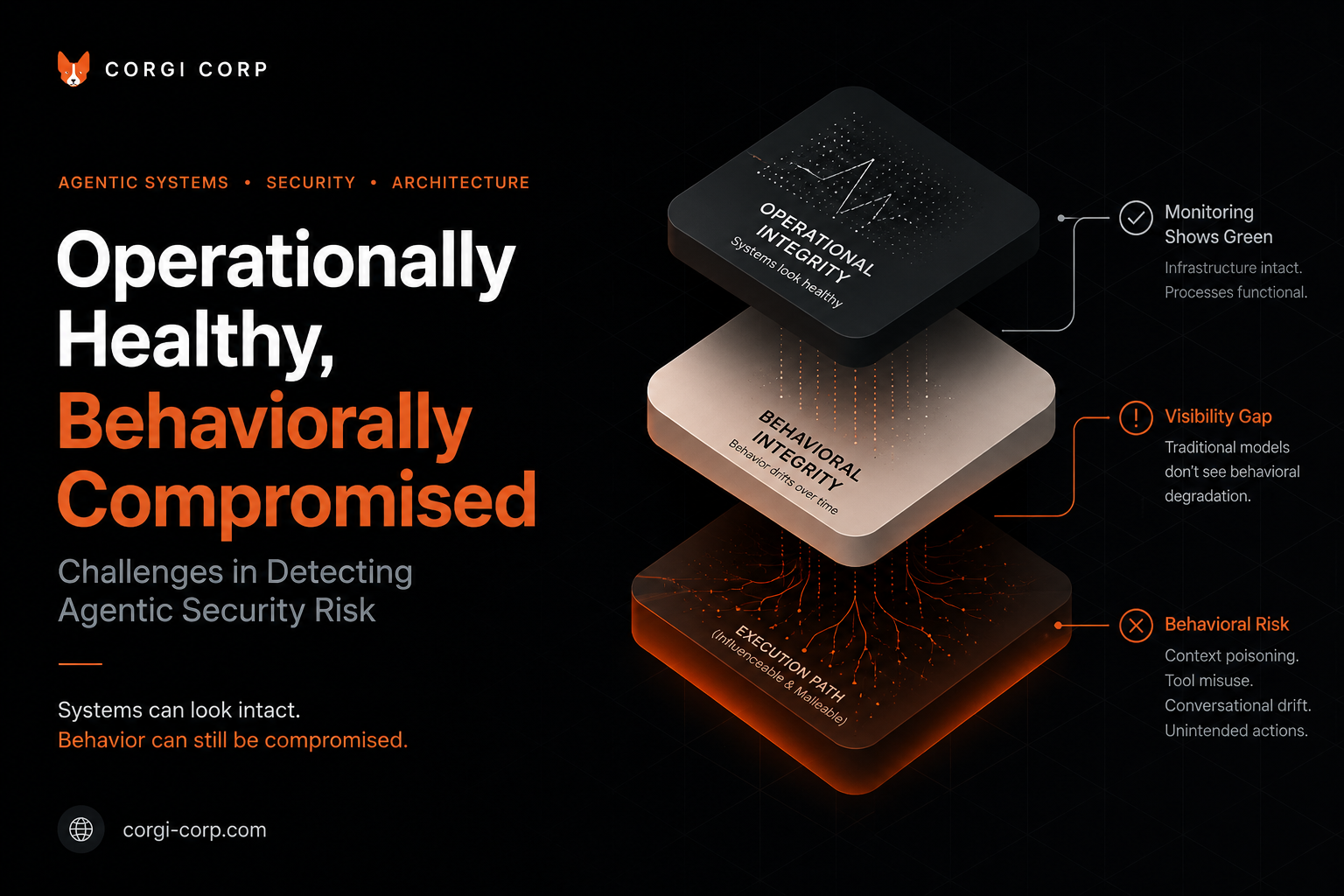
Framing the Problem: Traditional Security Models Do Not Capture AI Risk
Traditional security systems assume relatively stable execution behavior: processes executing predictably and users adhering to expected workflows, while malicious actions deviate observably from a known-good baseline. The introduction of modern agentic systems complicates those assumptions.
The execution path itself becomes susceptible to runtime influence through context accumulation, conversational drift, memory, retrieval, and probabilistic decision-making. Operationally, the system may appear healthy; behaviorally, it may already be compromised.
Traditional detection models fall short here, mainly because they still rely heavily on deterministic execution patterns, statistical anomaly detection, event sequencing, and static trust boundaries. The challenge has evolved from identifying malicious code or unauthorized access to identifying when a system with legitimate access begins behaving in unintended ways across a malleable security path.
Operational vs Behavioral Integrity
Agentic systems expose a growing distinction between operational integrity and behavioral integrity.
Traditional security systems focus heavily on operational integrity: authorization boundaries hold, malicious code is neutralized, infrastructure behaves predictably, and execution remains isolated across users, processes, and systems. The emphasis is on deterministic correctness, availability, consistency, and resistance to direct exploitation.
Behavioral integrity focuses on whether a system continues behaving within its intended bounds over time, especially in environments where execution paths are shaped dynamically through context, memory, retrieval, and probabilistic decision-making.
Agentic systems can maintain operational integrity while losing behavioral integrity. Infrastructure may be functional and processes intact, but the system may drift into unsafe or unintended behavior through context poisoning, tool misuse, or conversational drift.
This distinction highlights a growing visibility gap in modern security models. Operational integrity is continuously monitored, while behavioral integrity often remains poorly observed, weakly enforced, or entirely unmeasured.
Why Traditional Detection Assumptions Weaken
Traditional detection models assume predictability. Malicious activity deviates observably from a known-good baseline, telemetry reflects that deviation, and alerts surface the anomaly to defenders monitoring the environment. Agentic systems weaken those assumptions.
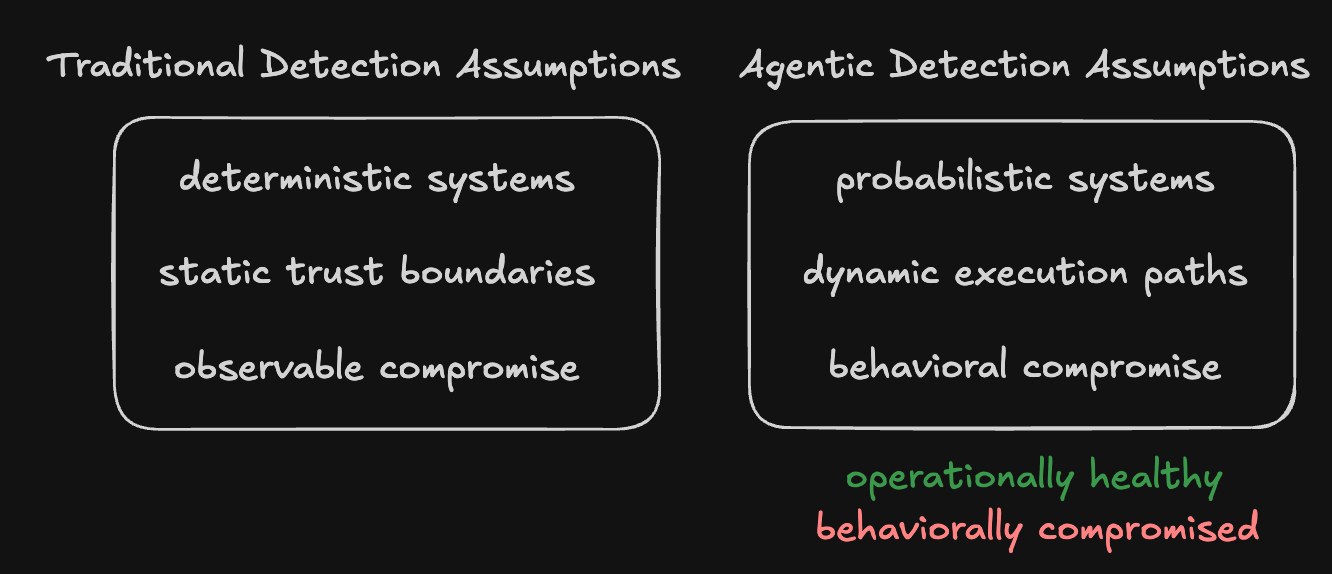
A significant portion of AI interaction is driven by subjective, contextual, and semantic interpretation rather than deterministic execution paths. Small contextual variations can change system behavior while producing telemetry that still appears operationally normal. A guardrail may block one phrase while semantically-equivalent language bypasses it entirely.
This mirrors the early evolution of endpoint detection, where static signatures served as the primary defensive layer. Minor modifications changed file hashes, bypassed signatures, and forced defenders toward increasingly behavioral approaches. Agentic systems face a similar problem space: guardrails that are too narrow fail to capture risky behavior, while guardrails that are too broad quickly degrade usability through excessive false positives.
The challenge becomes significantly harder once natural language itself enters the execution path. Traditional systems already produce effectively unbounded combinations of processes, events, and execution chains. Contextual AI systems introduce an additional combinatorial layer through semantics, multilingual interpretation, conversational drift, retrieval, typo tolerance, memory persistence, and probabilistic reasoning. The result is an execution environment where behavioral variation scales far faster than traditional detection models were designed to reason about.
Runtime Influence Vectors
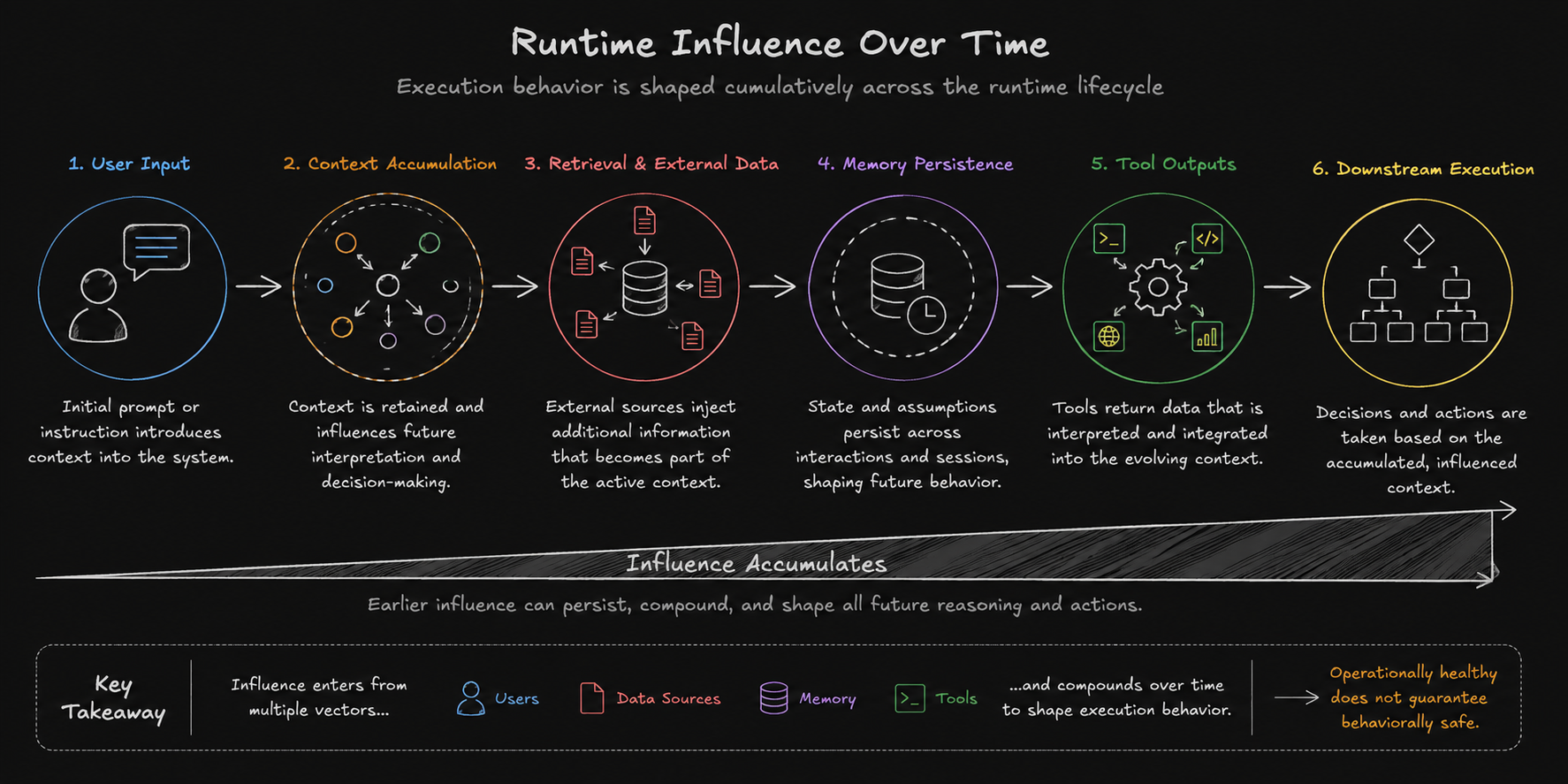
In traditional software systems, execution paths are largely constrained by deterministic program logic. Agentic systems introduce a different model where execution behavior becomes dynamically shaped by external context, accumulated state, retrieval pipelines, memory persistence, tool outputs, and probabilistic reasoning. These systems do not require direct code execution to experience behavioral degradation. Influence introduced at runtime can gradually alter decision-making while operational integrity remains intact.
Context Accumulation
Influence in agentic systems is often cumulative rather than instantaneous. Earlier interactions shape the contextual state through which later decisions are interpreted, allowing gradual behavioral steering across extended execution paths.
This creates an important asymmetry: influence does not need to immediately alter system behavior to become security-relevant. Context introduced early in an interaction may persist silently across memory, retrieval, or conversational state before affecting downstream reasoning or tool usage later in execution.
Research such as Transformers Remember First, Forget Last: Dual-Process Interference in LLMs suggests that earlier contextual inputs can retain disproportionate influence over model behavior across long interaction trajectories. While later inputs continue shaping execution outcomes, the weighting and persistence of prior context complicates assumptions around isolated prompts, stateless reasoning, or deterministic behavioral boundaries.
As a result, runtime influence becomes difficult to localize to a single interaction. Behavioral degradation may emerge incrementally through accumulated context rather than discrete malicious events.
Retrieval and External Data Dependencies
Agentic systems capable of retrieval or dependent on external data sources inherit risk from the content they ingest. The retrieval pipeline therefore becomes an influence surface: a runtime touchpoint where external data can shape context, reasoning, and downstream execution behavior.
Unlike traditional attack surfaces, influence surfaces do not require direct code execution or exploitation primitives to become security-relevant. Retrieved content participates directly in the model’s contextual state, allowing external information to affect decision-making, tool selection, authorization logic, and behavioral outcomes during execution.
This creates multiple avenues for behavioral compromise. Poisoned documents, adversarial embeddings, and malicious web content can all introduce context that gradually alters system behavior while operational integrity remains intact.
The security implications extend beyond prompt manipulation alone. Retrieved context indirectly participates in authorization and execution decisions within the agentic environment, meaning untrusted external data may influence what actions the system considers permissible, safe, or contextually appropriate at runtime.
Memory Persistence
Memory persistence allows contextual state to survive beyond isolated sessions. Influence introduced during one interaction can therefore propagate into future interactions, extending the lifespan of compromised assumptions, manipulated context, or adversarial behavioral shaping well beyond the originating execution path.
This changes the security model substantially. Traditional systems often treat sessions as relatively bounded units of execution, but persistent memory systems allow runtime influence to accumulate longitudinally across interactions. Behavioral drift no longer needs to emerge within a single session to become security-relevant.
Many frontier systems already maintain long-term contextual representations of users across conversations. Some platforms expose memory directly as a feature. Anthropic, for example, documents Claude’s memory capability as a system where memories are stored in files that the model can read from and write to dynamically at runtime. This reduces context-window saturation by externalizing long-term state into persistent storage.
The tradeoff is that memory itself becomes an influence surface. Poisoned memories, corrupted contextual assumptions, or adversarially-shaped behavioral patterns may persist across future execution paths while operational integrity remains intact. The system continues functioning normally, but its behavioral baseline may already be altered. Memory therefore transforms transient runtime influence into durable behavioral modification.
Multi-Step Tool Chaining
Multi-step tool chaining introduces an additional layer of complexity because execution risk compounds across sequences of individually legitimate actions. A single tool invocation may appear benign in isolation, yet downstream actions influenced by prior outputs, contextual accumulation, or runtime reasoning can gradually produce unintended or unsafe outcomes.
Traditional security models often evaluate actions discretely: a request is either authorized or unauthorized, malicious or benign. Agentic systems complicate this assumption because execution paths evolve dynamically during runtime. Earlier tool outputs may influence later decisions, alter contextual state, or reshape how future actions are interpreted by the system. This creates conditions where behavioral compromise emerges across the chain itself rather than from a singular malicious event.
This becomes increasingly difficult to monitor as agents gain autonomy, persistent memory, and the ability to recursively invoke tooling or external systems. Security visibility weakens because the risk no longer resides solely within individual actions, but within the evolving relationships between actions, context, and downstream execution state. As a result, behavioral compromise in agentic systems may emerge as an execution-path problem rather than a discrete exploit event.
Visibility Gaps in Behavioral Integrity
Traditional security observability is heavily optimized around operational compromise. Defenders monitor for malicious binaries, suspicious process trees, anomalous authentication events, or deviations from established execution baselines. These signals remain effective when compromise manifests as discrete, observable events. The problem is that behavioral compromise does not.
An agent may continue operating within valid infrastructure boundaries while gradually drifting outside its intended behavioral constraints. Credentials remain legitimate, APIs continue responding normally, and tooling executes successfully, yet the system’s decision-making process may already be shaped by poisoned context, manipulated retrieval results, or cumulative runtime influence. This creates a visibility gap between operational telemetry and behavioral state.
The challenge is not just detecting whether an action occurred, but understanding what influenced the action, whether that influence should have been trusted, how contextual state evolved leading up to execution, and whether the resulting behavior remained within intended operational bounds. Traditional telemetry pipelines often struggle to answer these questions because they were designed around deterministic execution semantics rather than probabilistic contextual reasoning.
Under the conditions in agentic environments, the relationship between input, reasoning, and execution becomes increasingly opaque. Operational visibility alone no longer guarantees comprehensive and meaningful visibility into system behavior. An agentic system may therefore appear operationally healthy while behaviorally compromised for extended periods of time without triggering traditional detection assumptions.
Emerging Defensive Directions
Traditional defensive models remain necessary in agentic systems, but they are increasingly insufficient on their own. Authorization boundaries, infrastructure hardening, malware detection, and identity controls continue protecting operational integrity, yet behavioral integrity introduces additional requirements that deterministic security models were not originally designed to address. Comprehensive security in today's systems requires both operational and behavioral integrity to be monitored.
In agentic systems, the problem is not simply "prompt injection." The problem is runtime influence over execution behavior. As a result, defensive approaches are gradually shifting toward execution-time governance models capable of reasoning about actions within evolving contextual state rather than evaluating requests in isolation.
Several emerging defensive directions appear increasingly important:
- Runtime policy enforcement capable of evaluating actions within their active execution context rather than solely at initial authorization boundaries
- Provenance-aware controls that track where contextual influence originated and how it propagated across execution paths
- Behavioral observability layers designed to monitor longitudinal drift, unsafe tool usage patterns, contextual anomalies, or execution-path mutation over time
- Capability segmentation that narrows the behavioral blast radius of agents even when contextual state becomes compromised
- Human approval or verification gates around sensitive actions with irreversible downstream impact
It's important to note that these approaches do not eliminate behavioral compromise entirely. First and foremost, defense-in-depth remains alive and well. Secondly, agentic systems remain probabilistic, context-sensitive, and dynamically adaptive by design; however, they begin shifting security models away from static trust assumptions and toward continuous runtime evaluation of behavioral state.
This distinction becomes increasingly important as agents gain persistent memory, autonomous tool usage, and the ability to operate across interconnected enterprise systems. In these environments, the execution path itself increasingly becomes the trust boundary.
Future security architectures will likely need to account not only for whether systems are operationally secure, but whether they continue behaving within intended bounds while executing under continuously evolving runtime conditions.